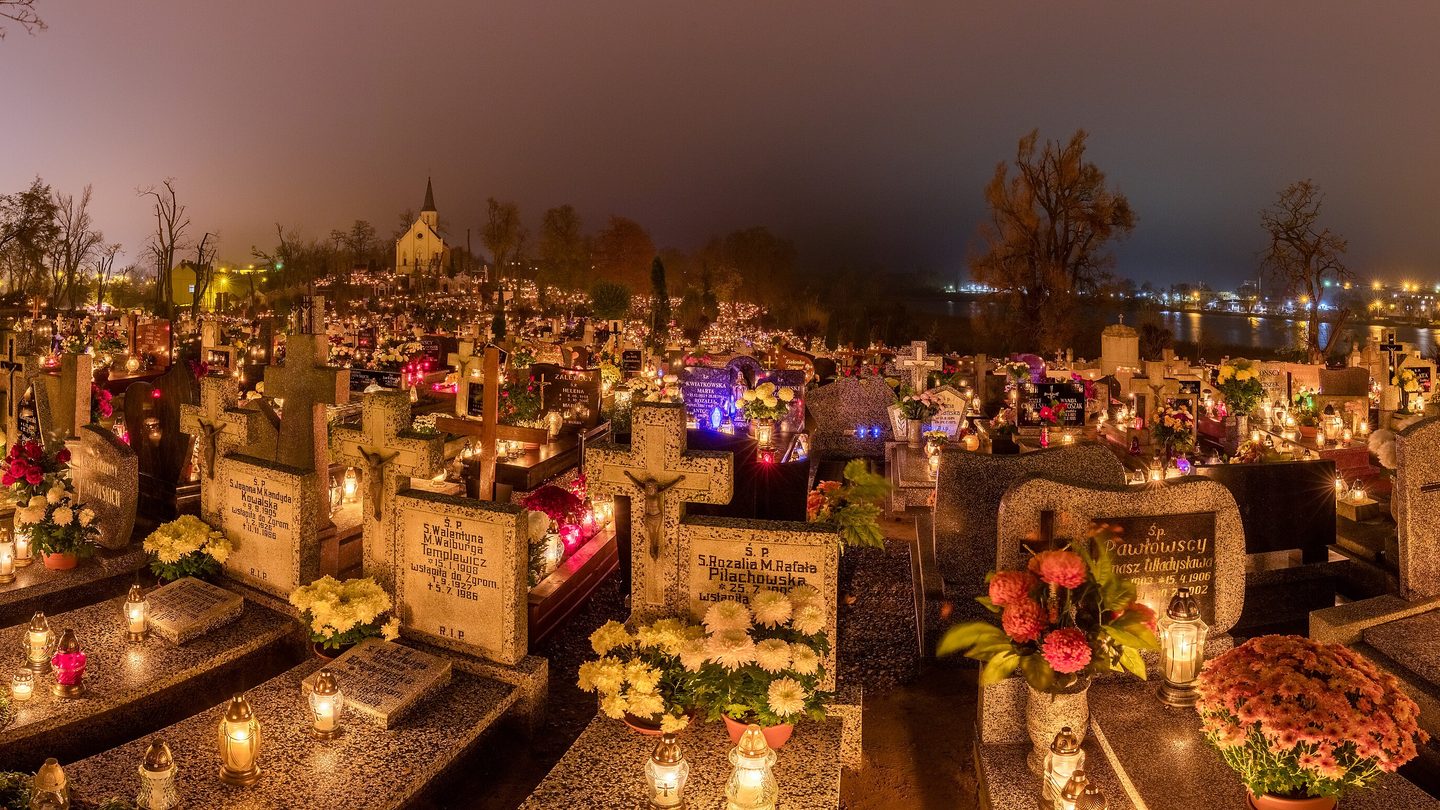
As evening falls, a Polish cemetery changes. Between the trees, the paths are joined by long ribbons of warm light. Red and clear glass lanterns stand beside family headstones, flowers cover the stone, and visitors tend a flame before staying a few minutes longer. This is no festive backdrop arranged for tourists. It is a meeting place with a family's own history.
On the first of November, Poland observes Wszystkich Świętych — All Saints' Day. Its roots are Catholic, yet visiting loved ones' graves has long been part of life for many non-religious families too. For a newcomer, it offers a glimpse of the country moving to a different rhythm: roads to cemeteries grow busy, everyday errands recede, and conversation returns to people who are no longer here.
You need neither imitate someone else's faith nor know prayers by heart. Understanding the day and behaving thoughtfully are enough. This article was checked on 23.10.2026: history and customs are distinguished from practical information for the approaching holiday, and regional treats from any supposedly compulsory nationwide menu.
All Saints' Day and All Souls' Day: neighbouring dates, different meanings
Wszystkich Świętych literally means “all saints”. In Catholic tradition, this is a solemn celebration of everyone who has attained sainthood: not only figures named in the church calendar, but also those unknown to the world. Its religious meaning therefore goes beyond the everyday description “day of the dead”. It is not solely about sorrow and loss.
The next day, 2 November, is Dzień Zaduszny, commonly called Zaduszki: All Souls' Day. It is devoted to prayer for the dead, particularly, in Catholic understanding, those still in need of prayerful help. ORPEG explains the distinction between the dates and their Polish customs. In ordinary conversation, people may simply talk about going “to the graves”, but the distinction helps make sense of the occasion.
The biggest cemetery visits often fall on the first day because it is a statutory public holiday, making family reunions easier. That does not mean everyone visits only then. Some clean a grave in advance, visit several cemeteries on different days or choose a quieter time. The adjacent dates form a shared season of remembrance while retaining their separate church meanings.
How the November calendar of remembrance took shape
The celebration has roots in early Christian commemorations of martyrs. An important episode was the dedication of Rome's Pantheon to Mary and the martyrs in 609, under Pope Boniface IV, recalled in this historical explanation from the Holy See. The present November date became established in the Western church during the Middle Ages; the wider observance is associated with the ninth century.
All Souls' Day has its own history. The practice of praying for the dead on the day after All Saints is associated with Abbot Odilo and the monastery of Cluny in 998. That marks the beginning of a particular monastic tradition, not a moment when all of Europe suddenly started observing an identical day.
The calendar developed gradually, encountering local ways of remembering ancestors. A neat claim that “Catholics simply renamed a pagan festival” is therefore too crude. It explains neither the church meaning of the two dates nor differences between places and periods. Seeing those layers offers a richer introduction to Poland than searching for a single dramatic legend.

Why families travel to cemeteries in early November
A family grave is not necessarily in the city where someone now lives. Jobs and studies take people to other regions, while parents and grandparents remain part of the story of home. A November journey may combine a cemetery visit, a family gathering and a return to a familiar street. That explains the traffic better than imagining a single compulsory ceremony observed by every resident.
Preparations begin before the holiday. Leaves are cleared from graves, the surroundings tidied, old lanterns checked and flowers chosen. There is plenty of everyday care involved: agreeing who will buy the pot of chrysanthemums, who needs help travelling and which gate to meet at. This ordinary work lies behind the cemetery's ceremonial appearance.
Visits extend beyond relatives. Lights appear on the graves of writers, performers and soldiers, and beside memorials to the fallen and victims of tragedies. Personal remembrance meets a city's and a country's memory. A visitor might recognise a name from a book cover, or notice a fresh flower left beside an otherwise unremarkable headstone.
Do not expect every family to behave alike. Some attend a service and pray; others stand quietly or recall the deceased person's character. Some people work, live far away or cannot travel for health reasons. The absence of a journey is no measure of someone's attachment.
Chrysanthemums and znicze: familiar signs of care
Chrysanthemums are among the most recognisable flowers in a Polish cemetery in November. Dense white, yellow and burgundy plants fill pots alongside bouquets and other arrangements. They are a practical seasonal choice too: an autumn flower suits the cooler weather. There is no need to assign every shade a fixed meaning, as though a family must be sending a coded message.
A znicz is a memorial lantern, often with a glass casing and a protective lid. It differs from a candle simply placed in a holder on a dining table. Replaceable inserts and different sizes are available; the choice depends on habit, space and a safe position for the flame. In a contemporary setting, light is readily understood as a sign of memory and presence: this person has not been forgotten.
You do not have to buy the largest arrangement or surround a grave with lights. It matters more not to obstruct neighbouring plots, leave an unstable flame or ignore the cemetery's disposal rules. If you arrive with a Polish family, asking whether help is needed is easier than trying to infer an elaborate ritual from the objects alone.

What a family day might look like
Picture a familiar sequence of errands rather than a particular invented family. Flowers are bought the previous day and travel arrangements checked. Morning brings less of the usual rush to work, although the journey itself may be long. Some visit their parents; others meet relatives at the cemetery gates. The bag contains lanterns, matches, gloves and something warm to wear.
At the grave, flowers are adjusted, a light is kindled and short memories exchanged. Children hear who the person in the photograph was, why their name recurs in the family or where they lived. Conversation need not remain solemn throughout: a warm everyday anecdote can bring someone's personality back more vividly than a general statement about remembrance.
Afterwards, relatives may share lunch, call on older family members or continue to another cemetery. Some return in the evening to see the lights; others stay at home. This is one possible pattern, not a guide to being “properly Polish”. Family habits depend on distance, age, faith and personal memories.
What people eat on 1 November: family lunches and regional sweets
There is no single Polish dish that everyone must cook for All Saints' Day. A family gathering may continue over hot soup, a home-cooked main course, tea and baking. But beetroot soup, rosół broth, cake or a meat dish in one household remain the hosts' choice, rather than a national rule for the date. Not every photograph of an autumn lunch proves the existence of a special holiday menu.
Warsaw and Mazovia: pańska skórka
The small-scale trade around cemeteries is particularly interesting. Warsaw and Mazovia are known for pańska skórka, a homemade confection usually sold in pieces wrapped in thin paper, in various colours and flavours. The Museum of Warsaw collected memories of it as part of the city's intangible heritage. It shows how a taste becomes connected with a family outing and a place, rather than with a compulsory religious instruction.
Kraków: miodek turecki
Near Kraków's cemeteries, you may find miodek turecki: a pale, sweet confection with nuts, historically sold by breaking pieces from large blocks. The city's Kraków publication describes the tradition using ethnographic material. The name literally suggests “Turkish honey”, but does not itself establish a particular Turkish origin. Local history is firmer ground than an enticing conclusion drawn from a name.
| Sweet | Where the tradition belongs | What to know |
|---|---|---|
| Pańska skórka | Warsaw and Mazovia | Paper-wrapped pieces; a city tradition associated with cemetery stalls |
| Miodek turecki | Kraków | Pale confection with nuts; a regional custom, not a nationwide menu |

Dziady, ancestral remembrance and the difference from Halloween
Remembrance customs long predate car journeys and glass lanterns. Ethnographic accounts describe food for the dead, fires and help for wanderers, alongside different ideas about the connection between the living and their ancestors. Pracownia Etnograficzna explores this autumn calendar. These descriptions belong to particular places and historical circumstances; they do not prove that cemetery visitors today believe souls return to their homes.
Dziady is also familiar as the title of a work by Adam Mickiewicz. Literature helped sustain interest in the old rite, but an artistic scene should not be read as reporting from a contemporary Polish cemetery. Church history, folk beliefs and family memory intersected. Reducing them to one unchanging tradition loses the most interesting element: change over time.
Halloween, commonly associated with the eve of All Saints, costumes and entertainment, is a different kind of occasion. A modern family may have both a children's party and a quiet visit to graves the next day. There is no need to declare the two mutually exclusive or assume the whole country views them identically. In a cemetery, take your cue from the place itself, rather than importing the mood of a costume party.
1 November 2026: practical details
In 2026, 1 November falls on a Sunday. It is a statutory public holiday. The second of November is not a separate nationwide public holiday, so do not assume every office will be closed then. Holiday status also does not stop all work: transport, healthcare and other essential services operate under their own arrangements.
Most ordinary shops close for the holiday, with statutory exceptions for certain kinds of trade and services. Check the particular pharmacy, petrol station, small shop or café separately. Buy what you need ahead of time; flowers and lanterns are not guaranteed to be available at your usual supermarket. Check the cemetery's own page or administration for opening hours too.
Large cemeteries may have additional services, changed stops and restrictions on car traffic. Last year's bus line is not this year's timetable, however. In Warsaw, consult official transport and road notices; elsewhere, use the municipal portal and local operator. This article contains no invented holiday routes: check both your outward and return journeys shortly before travelling.
A first visit without feeling out of place
- Choose a cemetery and time, then check entrances, opening hours and transport home.
- Dress for the weather: an evening stroll and standing at a grave feel colder than walking briskly through town.
- Keep to paths, do not occupy a family's space for a better camera angle, and leave other people's decorations alone.
- Take photographs sensitively: follow local rules and do not photograph grieving people close up without consent.
- Do not leave open flames in arbitrary places; if you light a lantern, choose an appropriate spot and follow local guidance.
Getting to know the tradition does not require buying a candle or joining a prayer. A quiet walk, reading names and respecting those who have come for personal reasons can tell you a great deal. Memory expressed through silence is no less real.
If relatives or friends invite you, ask about their plans and how you can help. Finding your feet in everyday Polish life also happens through these small conversations. New words are easier to remember in real settings — alongside accessible ways to learn Polish, without needing to speak perfectly from the start.
Useful Polish words and expressions
- Wszystkich Świętych — All Saints' Day.
- Zaduszki / Dzień Zaduszny — All Souls' Day, a day of prayer for the dead.
- Znicz, plural znicze — a memorial grave lantern.
- Chryzantema — chrysanthemum.
- Cmentarz — cemetery.
- Grób, plural groby — grave.
- Pamięć — memory; pamiętamy means “we remember”.
- Odwiedzić groby bliskich — to visit loved ones' graves.
Frequently asked questions
Do you have to be Catholic to visit a cemetery?
No. You can get to know the tradition quietly, following the site's rules and respecting visitors' personal space.
Are the first and second of November the same celebration?
No. The first is Wszystkich Świętych; the second is Zaduszki. Family visits and remembrance may span both days.
Must I buy a lantern?
No. It is a customary sign of remembrance, not an admission ticket. If you light a flame, do so safely and in an appropriate place.
What must people eat that day?
There is no compulsory nationwide menu. Lunch depends on the family; pańska skórka and miodek turecki belong to particular regions.
May I photograph the evening lights?
Check local rules. Even where photography is allowed, do not disturb families or turn someone else's experience into a staged scene.
Are all shops closed without exception?
Ordinary trade is restricted by holiday rules, but the law allows exceptions. Check the particular outlet, especially if you need medicine or food while travelling.
What day of the week is 1 November 2026?
Sunday. Plan shopping and travel ahead, and check your city's special transport announcements.
Can I visit without Polish relatives?
Yes. Treat the cemetery as a place of remembrance, not an attraction. Joining prayers or buying flowers is not compulsory.
The people behind the lights
The beauty of an evening view is only part of this November day. Behind each lantern may lie a journey from another city, a habit inherited from parents or a brief conversation about someone a child never met. Such remembrance does not demand identical words from everyone.
Looking more closely at the tradition means noticing the people behind its visible signs. The cemetery lights then make sense without mystical explanations: they help the living stay connected with their history and find time for one another.
Photography and licences
- Photo: Diego Delso, CC BY-SA 4.0. Resized and cropped for the website; the photograph retains its licence.
- Photo: Marek Ślusarczyk (Tupungato), CC BY 3.0. Resized and cropped for the website; the photograph retains its licence.
- Photo: Agata Stanisz, CC BY-SA 3.0 pl. Resized and cropped for the website; the photograph retains its licence.
- Photo: Jacek Halicki, CC BY-SA 4.0. Resized and cropped for the website; the photograph retains its licence.


